
This document provides a textual narrative of RDC’s working perspective of the City of Saskatoon’s (CoS – City) stormwater policy framework and present the regulatory mechanisms in place from a unique perspective. It attempts to identify all know regulatory documents that practically govern design, connection, grading, constructability, incentives, and environmental integrations for stormwater works in Saskatoon and explains how they interlock during municipal review.
Relevant City of Saskatoon Standards & Policies
- Design & Development Standards Manual, Version 17
- Section 6: Storm Water Drainage System
- Defines hydrologic & hydraulic performance criteria (detention sizing, peak-flow control, LID integration).
- Applies to all new subdivisions, major site redevelopments, or any work altering the city’s drainage network.
- Ensures consistent flood protection, optimized system capacity, and alignment with Saskatoon’s sustainability targets—streamlining approvals by reducing redesign cycles.
- Section 7: Storm Water Drainage System (Private Connections)
- Establishes requirements for tying private drainage (roof leaders, foundation drains, yard grading) into municipal mains, including on-site grading tolerances and outlet specifications.
- Triggers on any development or renovation that changes surface or subsurface runoff paths on private property.
- Prevents overloads on public infrastructure, minimizes grading conflicts, and avoids costly re-grading orders under the Drainage Bylaw.
- Section 6: Storm Water Drainage System
- Drainage Bylaw No. 9772, 2021
- Grading controls, inspections, asbuilt certification, professional stamping.
- Specifications & Standards Manual: Water & Sewer Construction
- Standard installation, materials, and drawing conventions for storm infrastructure.
- Service Connections Guidelines
- Tiein procedures, design runoff coefficients, and minor system routing requirements.
- Low Impact Development: Design Guide for Saskatoon
- Best Management Practices (BMPs) for reduction of Equivalent Runoff Units (ERUs) and credit program.
- Stormwater Management Credit Program, Bylaw 9545
- Eligibility and calculation methodology for stormwater quality/quantity control credits.
In practical terms, the Design & Development Standards Manual (DDSM) Section 6 establishes hydrologic and hydraulic performance criteria for minor and major systems, and DDSM Section 7 governs how private systems connect to the municipal network. The Drainage Bylaw enforces propertylevel grading, onsite capture, and certification, while the Saskatchewan Plumbing Code Regulations require connection of storm drainage to an approved public system or designated disposal location.
The City’s Specifications and Standard Drawings translate performance criteria into constructible details. The Storm Water Management Utility Bylaw and the LID) Design Guide provide incentives and best practices that can shape detention and water quality strategies. The Wetland Policy and Wetland Design Guidelines apply where naturalized facilities or wetlands are involved.
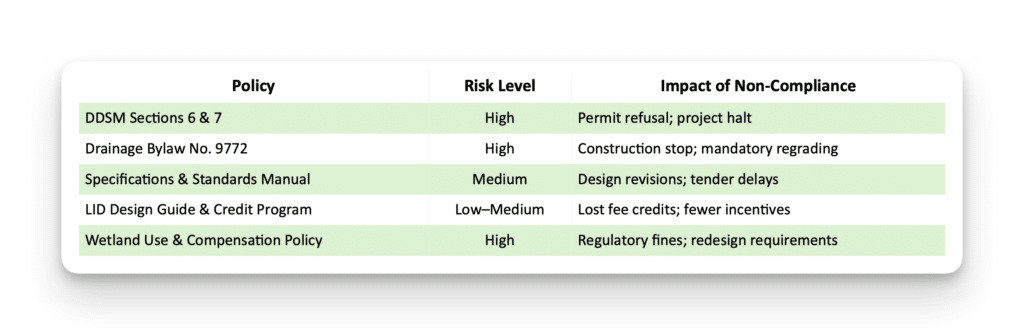
For municipal tiein projects, DDSM Sections 6 and 7 and the Drainage Bylaw are highrisk controls because noncompliance is likely to prevent approval or halt construction. The Plumbing Code is high risk whenever connection pathways are at issue. Specifications, LID guidance, Utility Bylaw credits, and Wetland guidance range from medium to low risk; these typically influence conditions of approval, cost, and operations rather than outright compliance.
Policy Categories & Strategic Insights
Below we have organized Saskatoon’s six cornerstone standards into three thematic pillars—Design Excellence, Construction & Compliance, and Environmental Leadership—infused with strategic context to illustrate how each policy interacts within the city’s operational and planning systems.
A. Design Excellence
- DDSM Section 6: Storm Water Drainage System
- Scope: Hydraulic modelling requirements, peak flow control, and Low Impact Development (LID) integration.
- When: All new subdivisions and major site redevelopments.
- Why: Ensures precision in detention sizing and green infrastructure design, reducing flood risk and aligning with Saskatoon’s sustainability goals.
- Systems Note: Viewing Section 6 as part of a larger network of stakeholders—designers, review engineers, and budget planners—creates feedback loops that streamline approvals and minimize redesigns.
- DDSM Section 7: Storm Water Drainage System (Private Connections)
- Scope: Guidelines for private-to-public discharge points, grading controls, and outlet specifications.
- When: Any project altering roof drains, foundation systems, or site slopes.
- Why: Protects municipal mains from unintended loads and maintains clarity of responsibility between private property owners and the city.
- Systems Note: Early collaboration with reviewers on connection schematics prevents downstream conflicts and costly regrading orders.
B. Construction & Compliance
- Drainage Bylaw No. 9772
- Scope: Mandatory grading certifications, easement requirements, and professional compliance documentation.
- When: Pre-construction grading plan submission and post-construction P.Eng. certification.
- Why: Provides legal assurance that on-site grading matches design intent, safeguarding occupancy permits and municipal assets.
- Specifications & Standards Manual
- Scope: Technical construction standards for materials, installation depths, bedding protocols, and manhole layouts.
- When: Detailed design and tendering phases.
- Why: Guarantees constructability, reduces contractor claims, and preserves budget integrity by adhering to city-approved technical criteria.
C. Environmental Leadership & Incentives
- LID Design Guide & Stormwater Credit Program
- Scope: Best practices for green infrastructure and methodology for ERU fee credits.
- When: Voluntary enrollment for fee reductions.
- Why: Aligns ecological outcomes with financial incentives, lowering development fees while promoting sustainable stormwater strategies.
- Wetland Use & Compensation Policy
- Scope: Protection, alteration allowances, and compensation frameworks for wetlands.
- When: Any activity impacting natural or constructed wetland areas.
- Why: Ensures that ecological integrity is preserved, regulatory requirements are met, and community values for natural assets are upheld.
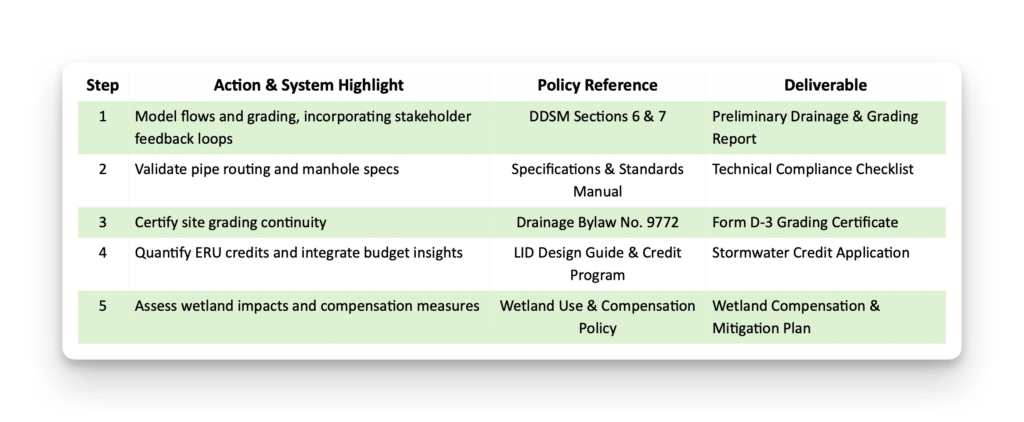
Integrated Review Roadmap
Streamline your project submissions with this clear, sequential process—augmented by light systems thinking cues to highlight interdependencies.
Risk-Level Matrix
Identify critical policies, assess potential impacts of non-compliance, and prioritize accordingly: