

This document provides a textual narrative of RDC’s current perspective of the City of Saskatoon’s (CoS – City) practical framework governing commercial water service design—with a deliberate focus on differentiating Fire Flow, domestic service design demand, and sprinkler/fire protection demand, and on how those concepts interlock with CoS standards, bylaws, and construction specifications during municipal review.
Like our stormwater policy landscape resource, the objective is not to restate every clause of every document, but to identify the “governing stack” that actually drives outcomes, highlight where misinterpretation occurs, and outline a review-ready submission pathway that reduces redesign cycles and approval friction.
Core Differentiation: Three Demands, Two Systems, One Submission File
Commercial water service reviews often go sideways for one simple reason: different stakeholders use the same words to describe different design intents.
1. Fire Flow (FF)
Fire Flow is fundamentally a public fire protection / municipal distribution consideration—the ability of the City system (mains/hydrants) to support firefighting in the vicinity of the site. It is typically assessed using distribution/hydrant information and recognized public fire protection references, and it is not automatically the flow that a building’s domestic service line must be sized to convey.
2. Service Design Demand (Domestic Demand)
Domestic service design demand is the building’s operational demand—commonly derived using the fixture-unit method under the National Plumbing Code (NPC)—and is used to size the domestic service, meter, and domestic distribution. Saskatchewan has adopted the 2020 edition of the NPC, making fixture-based domestic sizing a valid governing basis in the provincial building/code environment.
3. Sprinkler / Fire Protection Demand
Sprinkler/fire demand (when applicable) is a private fire protection design demand governed by the project’s fire protection design basis (NFPA, etc.). The critical policy risk is not the existence of sprinkler demand—it’s whether the submission clearly states whether the sprinkler demand is on a separate fire service or on a combined service, so it cannot be misinterpreted during CoS review.
Practical rule:
If your report or drawings do not explicitly declare service configuration (separate vs combined), reviewers may infer intent incorrectly—especially when Fire Flow data is present in the project file.
Relevant City of Saskatoon Standards & Policies
- Design & Development Standards Manual (DDSM), Version 17 (current posting)
- Section 4: Water Distribution System
- Defines objectives for safe potable water and adequate pressure for domestic applications.
- Requires modelling and submission of a Water Distribution Plan for applicable development contexts, including documentation of assumptions (pressures, pipe materials, coefficients, etc.).
- Explicitly references public fire protection guidance (e.g., Fire Underwriters Survey) within the water distribution design reference stack—reinforcing that FF belongs to the distribution/public protection layer.
- Section 7: Service Connections
- Establishes requirements for water and sanitary service connections, including alignment, separation from property line, depth, minimum sizing, and connection documentation/records for final acceptance.
- Directs that sprinkler service mains be sized as specified in NFPA standards (i.e., sprinkler sizing is not a domestic fixture-unit exercise).
- Ties backflow device requirements to Waterworks Bylaw No. 7567 and applicable City drawings, and references CAN/CSA backflow device selection guidance.
- Section 11: Drawing Requirements and Standards
- Requires drawings for alterations/additions to City-owned water systems and reserves the right to require resubmission where drawings do not comply with City standards.
- Section 4: Water Distribution System
- Waterworks Bylaw No. 7567
- Establishes and regulates the supply, storage, and distribution of water and sets terms for public utility water service.
- Private Sewer and Water Service Connection Bylaw No. 8880
- Establishes conditions and procedures for construction/installation of private sewer and water service connections, including tapping to City main lines.
- Requires service connection work to be undertaken by a licensed contractor and constructed/installed in accordance with City specifications.
- Standard Construction Specifications and Drawings: Roadways, Water, and Sewer
- Converts design intent into constructible requirements (materials, installation, cut-offs, methods, inspection/tender expectations).
- Example: Specification 08025 – Water and Sewer Connections Construction
- Covers construction and cut-off of water/sanitary/storm service connections and regulates typical service connection construction ranges.
- Converts design intent into constructible requirements (materials, installation, cut-offs, methods, inspection/tender expectations).
- Cross Connection Control Program (CoS)
- A City program aimed at reducing contamination risk via backflow prevention expectations and compliance for commercial/industrial users, supported by the Waterworks Bylaw.
- Saskatchewan Code Adoption Layer (NPC / NBC / NFC)
- Saskatchewan adopted the 2020 editions of the National Building Code and National Plumbing Code effective January 1, 2024, by regulation—anchoring the fixture-unit domestic demand approach within the provincial code environment.
How These Documents Interlock in Practice
In practical terms:
- DDSM Section 4 sits at the municipal distribution level (system modelling, pressures, distribution assumptions, and public fire protection references). It is where Fire Flow thinking naturally lives.
- DDSM Section 7 governs the private-to-public interface: how the water service is laid out, how deep it must be, how minimum sizes apply, and how sprinkler service is treated differently (NFPA).
- The Waterworks Bylaw and Cross Connection Control Program anchor water quality protection and backflow expectations, which are often the “silent driver” of commercial service design outcomes (device selection, hazard classification, testing requirements).
- The Private Sewer and Water Service Connection Bylaw and City construction specifications regulate the legality and constructability of the connection work itself (who can do it, how it must be done).
- The NPC adoption layer supports the domestic fixture-unit demand basis for internal building plumbing and (by extension) domestic service sizing—distinct from FF and sprinkler demand.
Policy Categories & Strategic Insights
Below we’ve organized Saskatoon’s cornerstone water-service controls into three thematic pillars—Demand Clarity, Connection & Compliance, and Water Quality Protection—infused with strategic context to illustrate how each policy interacts within the City’s review system.
- Demand Clarity
- DDSM Section 4: Water Distribution System (Public System Layer)
- Scope: Distribution modelling expectations; pressure assumptions; reference stack includes public fire protection guidance
- When: New neighbourhood design contexts and any situation triggering Water Distribution Plan modelling/submission requirements.
- Why: Establishes the “public system reality” that frames what is possible at the site: pressure, distribution constraints, and public fire protection considerations.
- Systems Note: Treat Section 4 as the upstream constraint-set. If upstream assumptions are wrong, downstream service sizing becomes a redesign loop.
- Service Demand Declaration (FF vs Domestic vs Sprinkler)
- Scope: Clear definitions in the submission: what the domestic worksheet represents, what FF represents, and how sprinkler demand is treated (separate vs combined).
- When: Every commercial service sizing memo/report and drawing set.
- Why: This is the single most effective way to prevent review misinterpretation—especially when multiple disciplines (civil, mechanical, fire protection) contribute data.
- Systems Note: A one-paragraph declaration can eliminate weeks of back-and-forth by aligning reviewers, inspectors, and project stakeholders on intent.
- DDSM Section 4: Water Distribution System (Public System Layer)
- Connection & Compliance
- DDSM Section 7: Service Connections (Private-to-Public Interface Layer)
- Scope: Service connection geometry (alignment, offsets), depth criteria, minimum sizes, and connection record requirements; sprinkler service sizing direction to NFPA.
- When: Any new commercial connection, replacement, or tie-in impacting City mains.
- Why: Converts design into an inspectable, constructible service layout and clarifies where sprinkler standards govern sizing.
- Systems Note: Early coordination on service corridor and offsets prevents field rework and easement surprises.
- Private Sewer and Water Service Connection Bylaw No. 8880
- Scope: Conditions/procedures for private service construction and tapping; licensed contractor requirements; adherence to City specs.
- When: Construction, replacement, cut-off, demolition-driven changes, or any tapping scenario.
- Why: This is the legal backbone that governs “who can do the work” and “what standard governs the work.”
- Specifications & Standard Drawings (incl. Spec 08025)
- Scope: Construction means/methods, materials, and regulated approaches for building/altering service connections.
- When: Detailed design, tendering, and construction execution.
- Why: Reduces claims, change orders, and inconsistent field practices by anchoring details to City standards.
- DDSM Section 7: Service Connections (Private-to-Public Interface Layer)
- Water Quality Protection & Operational Resilience
- Waterworks Bylaw + Cross Connection Control Program
- Scope: Backflow prevention obligations and compliance expectations for commercial users; program support via Bylaw 7567.
- When: Commercial developments and any premise with a hazard classification requiring protection, testing, and documentation.
- Why: Water quality risk is existential risk—this is where review becomes “non-negotiable” if hazard/backflow is not addressed clearly.
- Systems Note: Backflow strategy is not a late-stage detail—device selection can influence service configuration, meter arrangement, and space planning.
- Waterworks Bylaw + Cross Connection Control Program
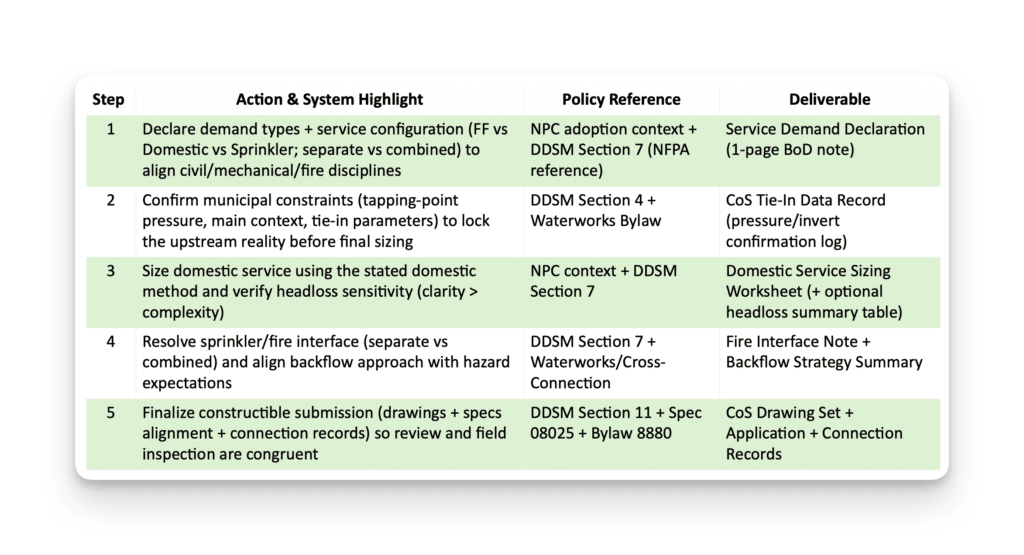
Integrated Review Roadmap
Streamline your water service submissions with this clear, sequential process—augmented by light systems-thinking cues to highlight interdependencies.
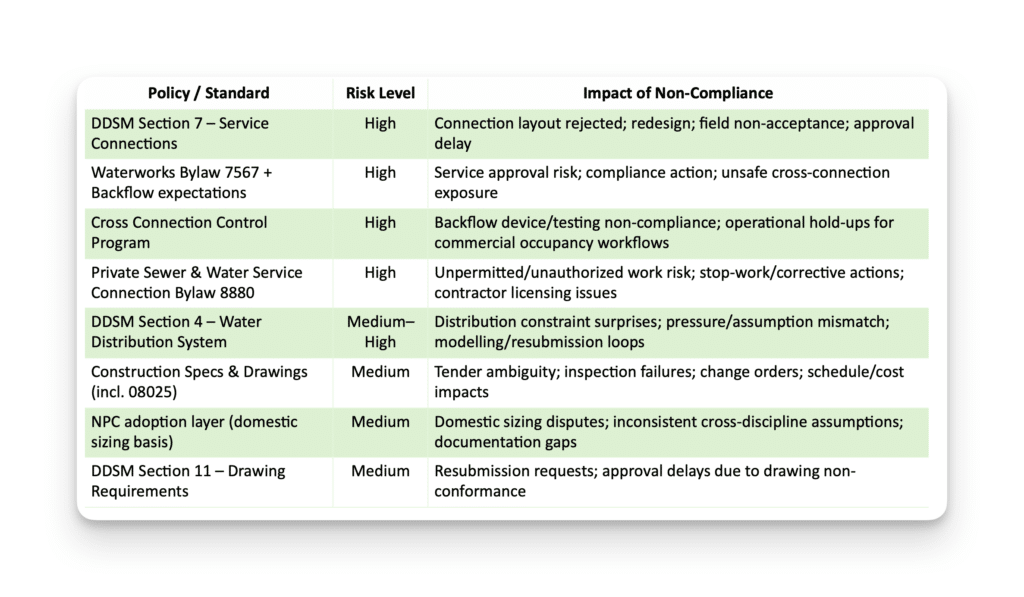
Risk-Level Matrix
Identify critical policies, assess potential impacts of non-compliance, and prioritize accordingly.
Closing Note: The “One Sentence” Fix That Prevents Most Commercial Water Service Misreads
If you only add one thing to your commercial water service report or cover sheet, make it this:
“Domestic water service sized for domestic demand (NPC fixture-unit basis); Fire Flow is a municipal distribution metric; sprinkler demand is addressed [on a separate fire service / via a combined-service sizing rule], and configuration is stated explicitly for CoS review.”
That single declaration usually prevents Fire Flow from being accidentally treated as a domestic sizing input, and it forces the combined vs separate service decision into the open—where it belongs.