

This document provides a textual narrative of RDC’s current perspective of the City of Saskatoon’s (CoS / City) practical framework governing commercial, industrial, and residential sanitary sewer design. It identifies the regulatory documents that practically govern design, flow modeling, service connections, pretreatment, and constructability, explaining how they interlock during municipal review.
Like our water and stormwater policy landscape resources, the objective is not to restate every clause of every document, but to identify the “governing stack” that drives outcomes, highlight where misinterpretation occurs, and outline a review-ready submission pathway that reduces redesign cycles and approval friction.
Sanitary sewer design reviews often encounter friction because they must satisfy two distinct but overlapping municipal priorities: the physical capacity to safely convey flows (hydraulics) and the chemical and physical quality of the effluent entering the public system (pretreatment). The fundamental objective of the CoS sanitary sewer system is to collect all sanitary sewage generated in a development and convey it to a wastewater treatment facility, and it must be designed to be separate from the stormwater drainage system.
Successfully navigating the CoS approval process requires an integrated approach. A designer must align the capacity and modeling constraints set out in Section 5 of the Design and Development Standards Manual (DDSM) with the private-to-public connection geometry dictated by DDSM Section 7. Simultaneously, the design must anticipate the strict effluent quality and pretreatment requirements—such as fat, oil, and grease (FOG) interceptors or oil/water separators—mandated by the Sewer Use Bylaw No. 9466 to protect the system from prohibited and restricted wastes. Finally, the physical execution of the connection must comply with the licensing and constructability conditions established in the Private Sewer and Water Service Connection Bylaw No. 8880.
By understanding how these documents interlock, proponents can proactively address both conveyance and compliance, thereby avoiding late-stage mechanical space conflicts, system blockages, and unpermitted work stops.
Core Differentiation: Conveyance Capacity vs. Effluent Quality
Commercial and industrial sanitary sewer reviews often experience delays because stakeholders blur the lines between two distinct mandates: the physical volume of wastewater the pipes can handle, and the physical/chemical makeup of the wastewater itself. Just as water service design must explicitly differentiate domestic demand from fire flow, sanitary design must clearly separate System Capacity from Effluent Quality.
1. System Capacity (Hydraulics)
System capacity is a macro-level infrastructure and modeling consideration. The fundamental rule of the City of Saskatoon’s network is that the sanitary sewer system must be designed completely separate from the stormwater drainage system. Any interconnectivity between the two is strictly prohibited.
From a capacity standpoint, the sanitary collection system must be sized to safely convey the Peak Design Flow (PDF). The PDF is calculated as the sum of the Peak Dry Weather Flow (PDWF) and the Infiltration & Inflow (I&I) allowance.
Note: While Weeping Tile Flow (WTF) allowances exist for modeling legacy systems, connecting foundation drains to the sanitary sewer is no longer permitted for new developments.
The hydraulic design must strike a delicate balance: the system must possess adequate capacity for these peak flows, while simultaneously maintaining a minimum mean velocity of 0.61 m/s during peak dry weather conditions to ensure the pipes are self-cleansing and function with minimum maintenance at low flows.
2. Effluent Quality & Pretreatment
While capacity focuses on the volume of the flow, effluent quality focuses on the content—specifically, the strict regulatory requirements designed to protect municipal infrastructure, treatment processes, and personnel from hazardous or damaging materials.
The Sewer Use Bylaw (Bylaw No. 9466) acts as the gatekeeper, strictly prohibiting the discharge of materials such as flammable liquids, corrosive matter, and solid matter larger than 12.5 mm into the sanitary sewer. Furthermore, it places strict concentration limits on “restricted wastes”.
For commercial and industrial sites, this translates directly to mandatory pretreatment facilities. Operations that generate fat, oil, and grease (FOG), such as restaurants or food processors, must install FOG interceptors. Similarly, facilities equipped with vehicle access doors, or those producing grit and petroleum-derived oils, must install grit interceptors and oil/water separators. All non-domestic wastewater from these operations is legally required to pass through the appropriate pretreatment facility before it discharges into the public sanitary sewer system.
The Strategic Takeaway:
A design submission that meticulously models Peak Design Flow but neglects to detail the required FOG interceptor or control manhole will face immediate review friction. If a design only focuses on pipe sizing (capacity) but ignores the pretreatment requirements (quality), it risks outright rejection, mandatory field retrofits, or non-compliance penalties down the line. Explicitly defining the pretreatment strategy alongside the capacity calculations aligns civil, mechanical, and municipal reviewers instantly.
Relevant City of Saskatoon Standards & Policies
- Design & Development Standards Manual (DDSM), Version 17 (current posting)
- Section 5: Sanitary Sewer Collection System
- Defines hydrologic and hydraulic performance criteria, including Peak Design Flow calculations, velocity limits, and capacity requirements for the public collection system.
- Applies to all new developments or extensions to the municipal network, ensuring adequate capacity and strict separation from the stormwater drainage system.
- Requires computer modelling and the submission of a Sanitary Sewer Collection Plan (and pump station reports, if applicable) for CoS verification.
- Section 7: Service Connections
- Establishes requirements for water and sanitary service connections, including alignment, separation from property line, depth, minimum sizing, and connection documentation/records for final acceptance.
- Sets out precise size and depth thresholds: services 150 mm or less may be tapped directly into the main, whereas services larger than 150 mm must connect via a manhole.
- Mandates drop structures, minimum slopes, and cleanout requirements where service geometry exceeds specified thresholds.
- Section 11: Drawing Requirements and Standards
- Requires drawings for alterations/additions to City-owned sanitary systems and reserves the right to require resubmission where drawings do not comply with City standards.
- Section 5: Sanitary Sewer Collection System
- The Sewer Use Bylaw No. 9466
- Regulates all direct and indirect discharges into the sanitary sewer system to protect municipal infrastructure, treatment processes, and human health.
- Strictly prohibits restricted wastes and legally mandates the installation and maintenance of pretreatment facilities, such as FOG interceptors, grit interceptors, and oil/water separators for commercial operations.
- Establishes requirements for control manholes and sample points to allow for City monitoring, sampling, and the application of surcharge fees.
- Private Sewer and Water Service Connection Bylaw No. 8880
- Establishes the legal conditions and procedures for the construction, installation, maintenance, and replacement of private sewer service connections.
- Mandates that all service connection work must be undertaken by a City-licensed contractor and explicitly inspected by the City before being covered.
- Standard Construction Specifications and Drawings: Roadways, Water, and Sewer
- Translates design intent into constructible field requirements, including transition width trench conditions, pipe strength, bedding protocols, and standard manhole installations.
- Saskatchewan Plumbing Code Regulations / National Plumbing Code (NPC)
- Governs the internal building drainage system and dictates the proper installation standards for fixtures, plumbing, and interceptors on private property prior to reaching the municipal connection.
How These Documents Interlock in Practice
In practice, a successful commercial or industrial sanitary submission does not treat the City’s regulatory documents as isolated checklists. Instead, they operate as an interlocking pipeline of compliance—from macro-level capacity and chemical quality, down to micro-level geometry and physical trench execution.
When design disciplines fail to view these codes as an integrated system, projects experience severe approval friction, late-stage redesigns, and field delays. By understanding the scope, triggers, and impact of each policy, proponents can see how they sequentially govern a project:
- DDSM Section 5 sits at the municipal infrastructure level, defining hydrologic and hydraulic performance criteria to ensure the public system can handle the development’s load. It mandates the calculation of Peak Design Flow (PDF) by combining Peak Dry Weather Flow (PDWF) and the Infiltration & Inflow (I&I) allowance, and enforces critical hydraulic parameters such as minimum self-cleansing velocity of 0.61 m/s and a maximum of 3.0 m/s.
- The Sewer Use Bylaw No. 9466 regulates the chemical and physical makeup of the wastewater, acting as the strict gatekeeper for what can and cannot be discharged. For commercial and industrial sites, the bylaw legally mandates pretreatment facilities—FOG interceptors, grit interceptors, oil/water separators—and requires an accessible control manhole on the owner’s property for City sampling.
- DDSM Section 7 governs the private-to-public interface, dictating the physical geometry of how a private building’s sanitary service connects to the municipal collection main. It sets precise size and depth thresholds: services 150 mm or less can be tapped directly, while larger services require a manhole connection. Drop structures are mandatory if the service pipe crown is 750 mm or more above the main’s crown.
- Bylaw 8880 and the Standard Specifications establish the legal rules, physical materials, and trench execution requirements for construction. All service connection work must be performed by a City-licensed contractor and inspected before being covered.
- The Saskatchewan Plumbing Code governs the internal building drainage system—fixtures, plumbing, and interceptors on private property—prior to reaching the municipal connection point.
The Strategic Takeaway:
Friction occurs when these documents are handled out of sequence or in silos. For instance, if a civil engineer models the connection to the main (DDSM 5 and 7) but the mechanical engineer fails to size and locate the required FOG interceptor and control manhole (Sewer Use Bylaw), the design will be rejected. An integrated submission explicitly proves that the effluent is clean enough to enter the system (Bylaw 9466), geometrically configured to physically tie in (DDSM 7), mathematically verified not to overwhelm the public pipes (DDSM 5), and legally executable in the field (Bylaw 8880).
Policy Categories & Strategic Insights
To translate the governing stack of City of Saskatoon standards and bylaws into an actionable workflow, we organize these requirements into three thematic pillars—Design Excellence & Capacity Management, Connection & Compliance, and Asset Protection & Pretreatment. Viewing these policies through these strategic lenses helps align the civil, mechanical, and municipal stakeholders early in the project lifecycle.
A. Design Excellence & Capacity Management
- DDSM Section 5: Sanitary Sewer Collection System
- Scope: Hydraulic modeling, system capacity verification, and pump station lifecycle planning.
- Governing Document: DDSM Section 5.
- When: All new developments or extensions to the municipal network.
- Why: The fundamental objective is to collect and convey all sanitary sewage to a treatment facility. The most critical early-design rule is absolute separation from the stormwater drainage system.
- Actionable Insights: Proponents must model the Peak Design Flow (PDF) as the sum of PDWF and I&I allowance. Weeping tile flow (WTF) allowances are no longer permitted for new developments. If a sewage pump station is required, the CoS requires a detailed Design Report including a 50-year present value life-cycle cost estimate.
- Systems Note: Treat Section 5 as your upstream constraint-set. If downstream capacity is exceeded, the project stops here—before any connection geometry is drawn.
B. Connection & Compliance
- DDSM Section 7: Service Connections (Private-to-Public Interface Layer)
- Scope: Service corridor geometry, physical connection parameters, and legal contractor requirements.
- When: Any new commercial connection, replacement, or tie-in impacting City mains.
- Why: Once municipal capacity is confirmed, the focus shifts to the micro-level geometry of tying the private building into the public main.
- Actionable Insights: Services should be laid in a straight line from the main to the building, at right angles, maintaining a minimum horizontal distance of 1.5 m from the property line. Services 150 mm or less can be tapped directly; anything larger requires a manhole. If the service pipe crown is 750 mm or more above the main’s crown, a drop structure is mandatory. Cleanouts are required where the service bends more than 45 degrees or exceeds 25 m.
- Systems Note: Early coordination on service corridor and offsets prevents field rework and easement surprises.
- Private Sewer and Water Service Connection Bylaw No. 8880
- Scope: Conditions/procedures for private service construction and tapping; licensed contractor requirements; adherence to City specs.
- When: Construction, replacement, cut-off, demolition-driven changes, or any tapping scenario.
- Why: Licensing is absolute—Bylaw 8880 makes it illegal to cover any service connection work before municipal inspection, and strictly mandates all work be performed by a City-licensed contractor.
- Specifications & Standard Drawings
- Scope: Construction means/methods, materials, and regulated approaches for building/altering service connections.
- When: Detailed design, tendering, and construction execution.
- Why: Reduces claims, change orders, and inconsistent field practices by anchoring details to City standards.
C. Asset Protection & Pretreatment
- Sewer Use Bylaw No. 9466
- Scope: Regulating effluent quality, protecting infrastructure from prohibited/restricted wastes, and physical space planning for interceptors.
- When: Any commercial or industrial development discharging non-domestic wastewater.
- Why: The City’s infrastructure and downstream treatment processes are highly vulnerable to restricted and prohibited wastes. This pillar is often a massive risk because civil engineers might assume mechanical engineers are handling it, and vice-versa, leading to critical omissions.
- Actionable Insights: Businesses producing FOG must install FOG interceptors. Facilities producing grit, petroleum-derived oils, or equipped with vehicle access doors must install grit interceptors and oil/water separators. FOG interceptors cannot be suspended from ceilings and must allow enough space to completely open the lid and remove baffles. Commercial sites must install and maintain a control manhole, typically as close to the property line as possible, for City sampling and monitoring.
- Systems Note: A frequent cause of late-stage redesign is failing to allocate physical space for pretreatment. Coordinate mechanical and civil scopes early to prevent space conflicts.
Integrated Review Roadmap
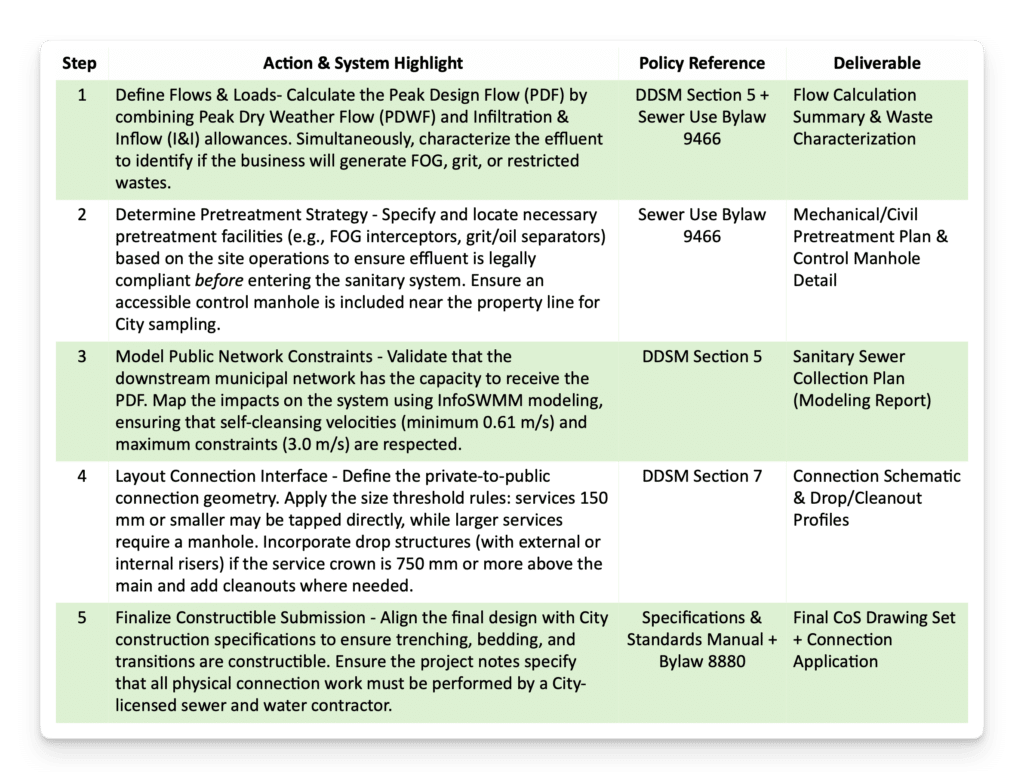
To streamline your commercial or industrial sanitary sewer submissions, proponents should follow a clear, sequential process that addresses both capacity and effluent quality. When disciplines operate in silos, the risk of redesign increases significantly. This roadmap is augmented by light systems-thinking cues to highlight the interdependencies between civil and mechanical design.
Risk-Level Matrix
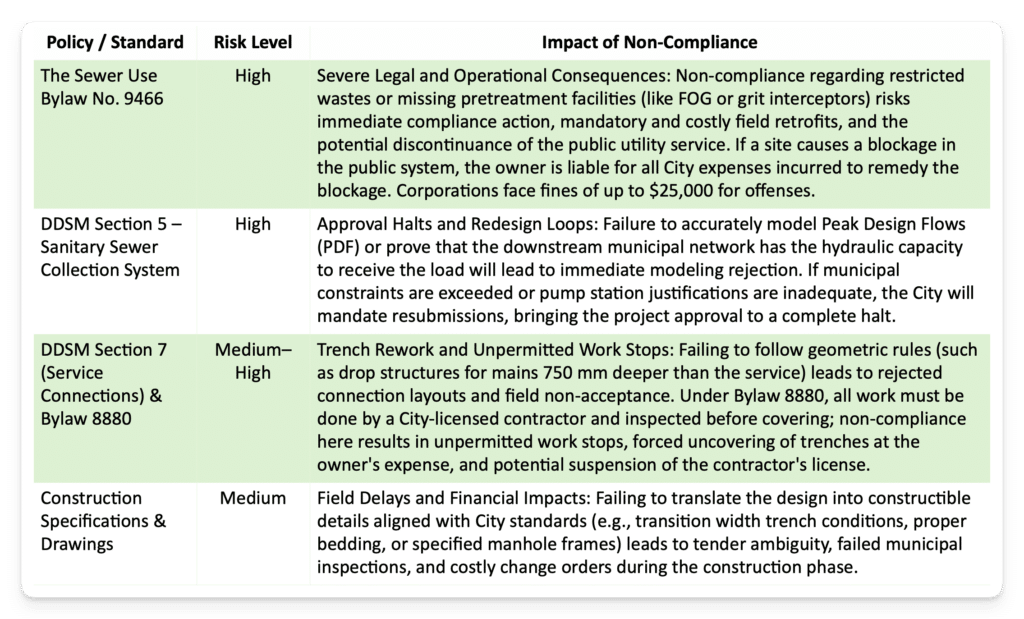
Identify critical policies, assess potential impacts of non-compliance, and prioritize accordingly.
Closing Note: The “One Sentence” Fix That Prevents Most Commercial Sanitary Sewer Misreads
If you only add one thing to your commercial or industrial sanitary sewer report or drawing cover sheet, make it this:
“Sanitary sewer service is sized for a Peak Design Flow of [X L/s] to meet CoS DDSM Section 5 capacity requirements, and all non-domestic effluent is pretreated via an explicitly sized and accessible [FOG / Grit / Oil-Water] interceptor, complete with a property-line control manhole, in full compliance with the Sewer Use Bylaw No. 9466.”
Just as water service designs often fail when reviewers confuse domestic demand with fire flow, commercial sanitary designs frequently face approval halts because the civil and mechanical scopes are submitted in silos. A civil engineer may perfectly size a 200 mm gravity pipe to handle the calculated Peak Design Flow (combining Peak Dry Weather Flow and Infiltration & Inflow). However, if the mechanical design fails to account for the mandatory pretreatment of restricted wastes, the entire design is fundamentally flawed.
By including this single declaration, you achieve three strategic goals instantly:
- It forces cross-discipline coordination: The civil engineer cannot write this sentence without actively confirming that the mechanical engineer has sized the required fat, oil, and grease (FOG) interceptor, grit interceptor, or oil/water separator dictated by the site’s operations.
- It proves compliance with the “Quality Gatekeeper”: It explicitly signals to the municipal reviewer that the chemical and physical quality of the effluent has been addressed under the strict regulations of the Sewer Use Bylaw No. 9466, bypassing the most common cause of commercial sanitary rejections and mandatory field retrofits.
- It confirms the monitoring interface: By declaring the presence of a control manhole located as close to the property line as possible, it assures the City that they will have the required safe, easy inspection access to sample the effluent before it enters the public main.
This “One Sentence Fix” prevents the City’s capacity reviewers (looking at DDSM Section 5 and 7) and environmental compliance reviewers (looking at Bylaw 9466) from having to hunt through disparate drawing sets to verify if the design is both hydraulically and chemically compliant. It forces the capacity vs. quality decision into the open, right on the front page.